
Uncategorized
Timber Moisture Guide for Better Reclaimed Builds

Aug
A beautifully weathered board can look ready for a new life, yet moisture hidden within the timber may still shape the outcome of your project. This timber moisture guide explains what to look for before reclaimed wood becomes flooring, shelving, furniture or a characterful feature wall.
Reclaimed timber has already lived through decades of changing temperatures, seasons and uses. That history gives it the saw marks, grain variation and honest patina that make it so distinctive. It does not, however, make it immune to movement. Like all wood, it responds to the moisture in the air around it.
Why moisture matters in reclaimed timber
Timber is hygroscopic, meaning it takes in and releases moisture until it reaches a balance with its surroundings. When it gains moisture, it expands. When it dries, it contracts. Across a wide solid board, that movement can be significant enough to open joints, cup a surface, cause a fitted shelf to bind or leave gaps in a floor.
Movement is most noticeable across the width of a board rather than along its length. It also varies by species and cut. Oak, pine, elm and tropical hardwoods each behave differently, while flat-sawn boards generally move more across their face than quarter-sawn boards. Reclaimed timber brings further variation because boards may have been exposed to different conditions during their first life.
This is not a reason to avoid reclaimed wood. It is a reason to respect it. A well-prepared reclaimed board can deliver exceptional durability alongside the warmth and authenticity that new, uniform timber often lacks.
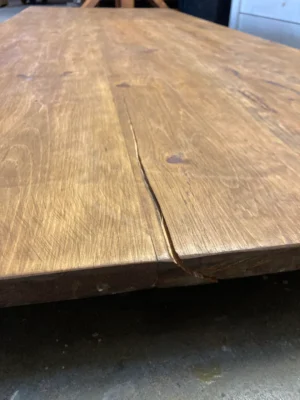
Timber moisture guide: the numbers to work towards
Moisture content is usually expressed as a percentage of the dry weight of the wood. There is no single perfect figure for every project, because the right level depends on where the finished piece will live.
For most heated homes in the UK, timber intended for furniture, internal joinery, shelving and interior wall cladding is commonly best worked once it has settled at around 8-12% moisture content. The drier and more consistently heated the room, the more important it is to let the timber acclimatise before final machining and fitting.
For a garage, garden room, unheated outbuilding or covered external setting, a slightly higher moisture content may be normal. Timber used outdoors will continue to respond to rain, humidity and changing seasons, so thoughtful detailing matters more than chasing an exact number. Allow drainage, ventilation and room for movement, and choose a suitable finish where appropriate.
Flooring deserves particular care. Boards fitted tightly while they are still too damp can shrink later, leaving visible gaps. Boards installed overly dry in a humid setting may expand and lift. If you are planning a reclaimed floor, bring the timber into the room where it will be laid and allow it to adjust before installation.
Relative humidity changes the answer
A moisture reading only makes sense alongside the environment. Central heating, underfloor heating, solid-fuel stoves, newly plastered walls and a damp renovation site can all change the relative humidity around your timber. A board that was stable in a cool workshop may move once it enters a warm kitchen.
This is why acclimatisation is not simply a matter of leaving timber indoors for a fixed number of days. The goal is for the wood to settle into the conditions of its final home. In a major renovation, wait until wet trades are complete and the building is reasonably dry before bringing in finished timber wherever possible.
How to measure timber moisture properly

A moisture meter is a useful investment for anyone making furniture, fitting floors or buying timber for a sizeable project. Pin meters measure electrical resistance between two probes, while pinless meters scan beneath the surface. Both can be helpful, but neither should be treated as magic.
Take several readings along the length and width of each board, especially on thicker pieces. Test both faces when you can. A reading from one dry edge does not confirm that the centre of a substantial beam is equally dry.
Pin meters can leave small holes, which are easily hidden on an unseen face or within an area to be machined. Pinless meters avoid marks, but rough-sawn surfaces, old paint, metal fixings, dense grain and uneven board thickness can affect their reading. Reclaimed timber may contain old nails, screws or concealed metal, so inspect carefully before testing, cutting or planing.
Meters also need the correct species setting or adjustment. If you are unsure of a board’s species, use readings as a guide and look for consistency across the stack rather than relying too heavily on a single decimal point. The timber’s appearance and behaviour still matter: fresh-looking end grain, a cool damp feel, surface mould or new distortion all deserve attention.
Acclimatising reclaimed boards before you build
Bring timber into the room or a similar dry, protected space before final fitting. Stack boards flat on level bearers, known as stickers, so air can circulate around every face. Keep the stack clear of bare concrete, external walls and direct heat from radiators or stoves.
Do not seal the boards in plastic. Trapped moisture encourages mould and prevents the timber from adjusting naturally. Equally, avoid leaning long boards against a wall for weeks, as they can bow under their own weight. A neat, supported stack protects both the timber and the time you have invested in selecting it.
How long should you wait? It depends on board thickness, the difference between storage and room conditions, and how stable the indoor climate is. Thin cladding may settle quickly; thick oak boards and beams may need considerably longer. Recheck with a moisture meter, inspect the boards for movement and make your final cuts as close to installation as practical.

Storing timber without inviting problems
Good storage preserves the character of reclaimed timber rather than allowing it to deteriorate. Choose a dry, ventilated space with a steady temperature. Keep stock raised from the ground, supported regularly along its length and protected from direct rain.
Avoid storing timber in a damp cellar, a recently plastered room or beneath a leaking roof. Covering a stack loosely from above can protect it from dust, but the sides should remain open to airflow. If boards arrive cold from an unheated yard, let them warm gradually rather than placing them immediately beside a powerful heat source.
For smaller quantities of offcuts, a rack is often more practical than a pile. Sort by thickness and length, and keep exceptional pieces aside for visible shelves, cabinet fronts or smaller furniture details. A short board with remarkable grain or old paint traces can become the focal point of a project rather than waste.
Allow for movement in the design
The strongest reclaimed-wood projects make room for timber to behave like timber. A wide solid-wood tabletop should not be rigidly fixed across its whole width to a frame. Use suitable fixings, slots or traditional joinery that hold the top securely while allowing seasonal movement.
For shelving, support long spans properly and avoid fixing a shelf so tightly between two walls that expansion has nowhere to go. When cladding a wall, use an appropriate batten system and leave considered perimeter allowances, particularly in rooms with changing humidity.
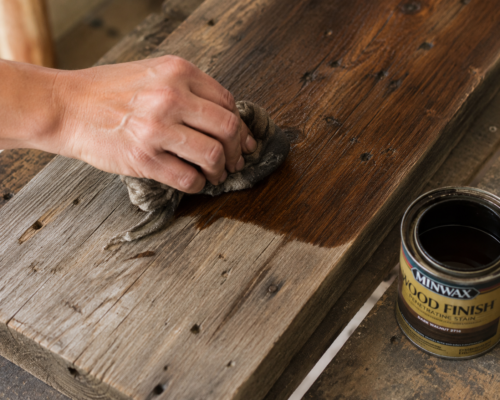
Finishes can slow moisture exchange, but they do not stop it entirely. Oil, wax, lacquer and paint each offer a different look and level of protection. Apply the chosen finish consistently, including edges and underside faces where suitable, to reduce uneven moisture uptake. For reclaimed timber, a test area is always worthwhile: a finish that deepens the grain beautifully may also darken old marks more than expected.
When a board is too wet or too dry
If timber is clearly wetter than the environment where it will be used, patience is the answer. Stack it correctly, improve airflow and allow gradual drying. Forcing the process with intense heat can cause surface checking, splitting and uneven drying between the outside and centre of the board.
Very dry timber can be just as awkward if it is about to enter a more humid space. Let it acclimatise rather than machining it to a final, exact fit on day one. If a board has severe cupping, deep splits, active insect damage or signs of rot, assess whether it is suitable for a decorative use, a shorter component or not for structural work at all.
Reclaimed timber is full of honest imperfections, but there is a difference between character and a defect that compromises performance. That judgement is part of good craftsmanship.
Choose timber with the finished space in mind
Before buying, think beyond the dimensions you need. Is the project going into a calm, heated sitting room, a busy kitchen, a humid bathroom or an unheated workshop? Will the boards be wide and prominent, or cut into smaller components where movement is less visible? Are you preserving a weathered face, or planing the wood to reveal fresh grain beneath?
At Kay Allan Timber Merchants, the appeal of reclaimed wood lies in both its practical strength and its individual story. Selecting boards with a project and environment in mind helps keep that story visible for years to come.
Give the timber time to settle, design with a little generosity and let its natural variation remain part of the finished piece. The best reclaimed-wood work does not fight the material’s past or its movement – it uses both to create something built to last.
